.png)
Building your dream home feels like holding a lightning bolt of an idea—exciting, powerful, but a little terrifying. How do you ground that energy and turn it into a real place for your family? This guide will walk you through finding the perfect Oklahoma custom home builder who can take your vision and build it into a reality, from finding land in Edmond to finalizing finishes. We’ll cover the critical steps, helping you avoid common pitfalls so you can move forward with confidence and turn that dream into an address.
Your Custom Home Journey Starts Here
Building a custom home is one of the biggest financial and emotional investments you'll ever make. This isn't just about sticks and bricks; it’s about crafting the space where your family will make memories for years to come. Whether you're picturing a sprawling modern farmhouse in Macomb or a sleek design in the OKC metro, it all starts with a solid plan and the right team.
At ACET Custom Homes, we understand the personal weight of this decision. With over 15 years of experience, we've guided countless families through this journey. Our entire process is built around a 'design-build' model, which simplifies communication, ensures budget transparency, and makes the experience enjoyable.
Why Oklahoma is a Prime Location for Your Dream Home
The secret is out—Oklahoma's custom and luxury home market is booming. Local builders are keeping up with the demand, and the state's impressive Realtor Affordability Score of 0.77 means high-end projects are often more attainable here than in many other parts of the country. We're seeing more and more professionals and families moving to the area for this very reason. You can dive deeper into Oklahoma's housing market trends to see the data for yourself.
What does this mean for you? It means your budget goes further, giving you more room for the custom details, premium materials, and energy-efficient systems that truly make a house a home.
The ACET Design-Build Advantage
Picking a builder is the single most important decision you'll make. The traditional route often involves hiring an architect, then an interior designer, and finally a builder—all as separate entities. That can get complicated fast. The design-build model, on the other hand, brings everyone together under one roof from the very beginning.
Here’s why that makes a huge difference:
- No More Runaround: You have one team and one point of contact. This cuts out the confusion and makes sure your vision doesn't get lost in translation.
- Real-World Budgets: We design with your budget in mind from day one. This prevents the heartbreaking scenario of falling in love with a design you can't actually afford to build.
- A Smarter Timeline: Because the design and construction phases can overlap, we can often get your project finished much faster.
"Our goal is to remove the friction points. When the design and build teams work in lockstep from day one, we can anticipate challenges, innovate solutions, and deliver a home that is both beautiful and buildable within the client's budget." - Bono, Project Manager at ACET Custom Homes
How to Vet Your Builder Beyond the Portfolio
Choosing the right Oklahoma custom home builder is easily the most important decision you'll make in this entire process. A beautiful portfolio is a great starting point, but let’s be honest—it only shows you the highlight reel. To find a true partner for your project, you need to dig much deeper into their process, communication style, and overall integrity.
This is about looking past the glossy photos to make sure the builder’s own foundation is as solid as the ones they pour.
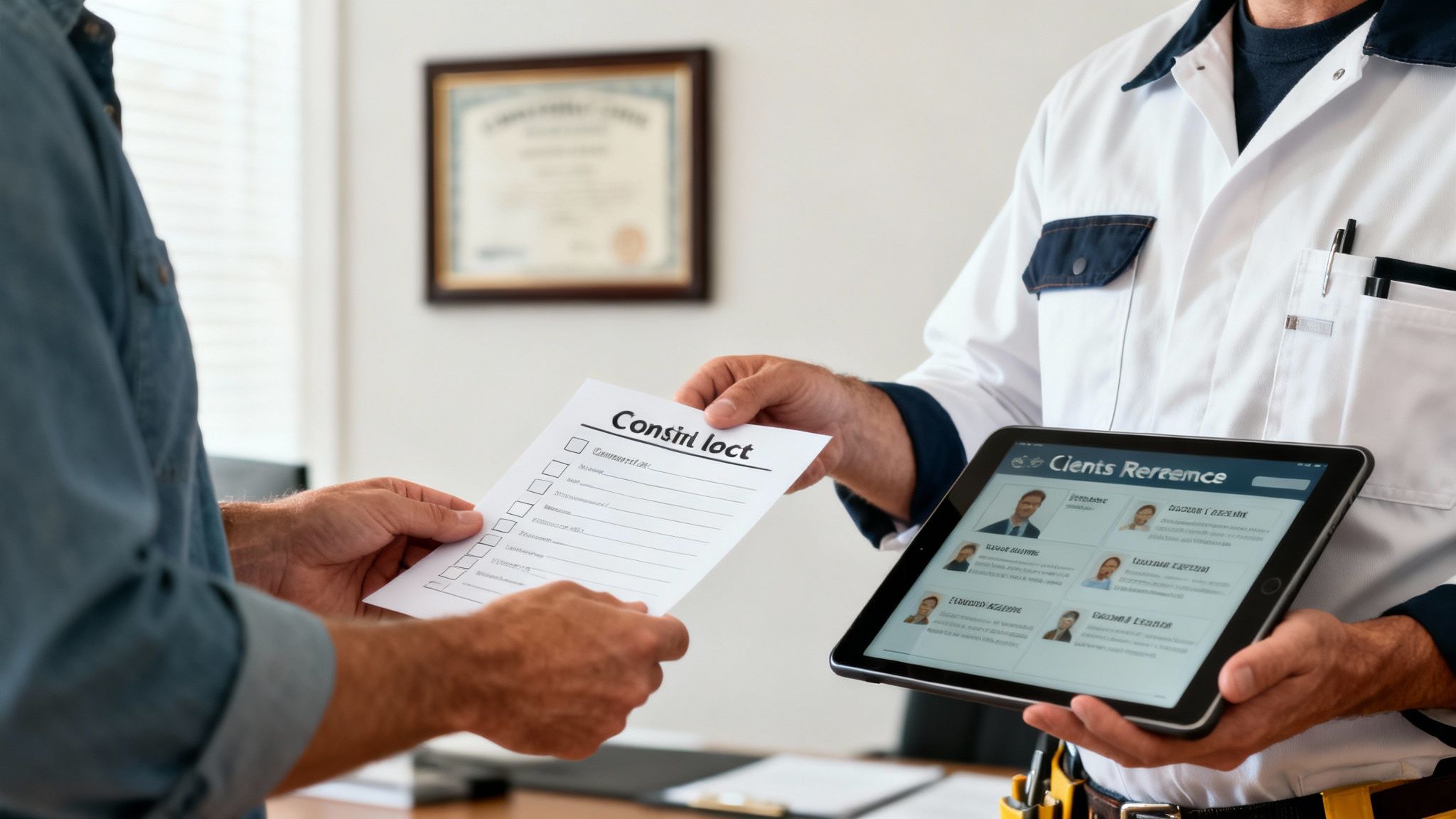
Any builder can show off their best work. The real test is how they handle the inevitable curveballs. This vetting process is your best defense against surprise budget overruns, frustrating communication gaps, and stressful delays. It’s how you ensure the team you hire to build your dream home in Deer Creek or on your rural land near Elmore City has a proven history of transparency and accountability.
Your Vetting Checklist Starts Here
Before you even think about signing a contract, it's time to do some homework. A trustworthy builder will welcome your questions and have clear, ready answers.
Here are the absolute non-negotiables:
- Verify Licensing and Insurance: This is ground zero. Ask for their Oklahoma license number and for proof of both general liability insurance and workers' compensation. You can (and should) verify their license with the Oklahoma Construction Industries Board. This is what protects you from liability if someone gets hurt on your property.
- Check Their Financial Stability: Don't be shy about asking for references from their primary bank and a few key suppliers. A builder with strong, long-term relationships is a fantastic sign of financial health. The last thing you want is your project grinding to a halt because your builder can't pay their vendors.
- Review Their Warranty Program: A quality builder stands behind their craftsmanship. Ask for a copy of their warranty upfront. A solid warranty should cover workmanship and materials for at least one year and major structural components for up to ten years.
Reading Between the Lines of Client Reviews
Online reviews can be a goldmine, but you have to know how to read them. Look for patterns, both good and bad. Are clients consistently praising the builder’s communication, or do you see repeated complaints about unreturned phone calls?
"They communicated through the entire process and were always quick to answer our questions. From beginning to end, we never felt left out of the loop." - A Past ACET Custom Homes Client
More importantly, look for reviews that explain how the builder solved a problem. Building a home is a complex dance, and things will go wrong. A five-star review that details how the builder masterfully handled an unexpected material shortage is infinitely more valuable than one that just says, "Everything was great." This is one of the key qualities in home builders you should be looking for.
Key Builder Vetting Criteria at a Glance
It's helpful to understand that not all builders operate the same way. The difference between a standard builder and a true design-build firm can have a huge impact on your experience. This table breaks down what to expect.
Seeing these differences laid out makes it easier to spot a builder whose process aligns with your expectations for a smooth, collaborative project.
Powerful Questions to Ask Past References
When a builder gives you a list of references, you can bet they are their happiest customers. Your job is to ask smart questions that get past the surface-level praise. Forget, "Were you happy with your home?"
Try asking these instead:
- "How did the builder handle an unexpected challenge, like a major weather delay or a subcontractor issue?" This gets right to their problem-solving skills and professionalism under pressure.
- "Would you describe their communication style as proactive or reactive? How often did you get updates?" This tells you everything you need to know about their commitment to keeping you in the loop.
- "How close did the final cost come to the initial budget? Were there any financial surprises you weren't prepared for?" This is a direct test of their estimating accuracy and financial transparency.
- "If you could change one thing about your experience working with them, what would it be?" Even the most satisfied clients can offer a nugget of constructive feedback that gives you incredible insight.
Taking the time to properly vet your builder is an investment that pays for itself a hundred times over. It’s the single most important step you can take to ensure your journey to a custom home is built on a foundation of trust, clear communication, and a truly shared vision.
Decoding the Costs of a Custom Home in Oklahoma
Talking about the budget for a custom home can feel a lot like trying to hit a moving target. As an Oklahoma custom home builder, we’ve found the best tool for our clients isn’t a hammer or a saw—it’s clarity.
Understanding the real costs, from buying the land to finally getting your keys, is what makes for a smooth, stress-free build. This isn't just about buzzwords like "transparency"; it's about building a project on a foundation of trust.
Your total investment isn’t just the house itself. It’s a whole ecosystem of costs: the land, getting the site ready, design fees, materials, labor, and all the finishes that make it yours. Knowing how these pieces fit together is the best way to avoid the kind of financial surprises that can turn a dream project into a nightmare.
Breaking Down the Core Cost Components
Long before the first wall ever goes up, a significant chunk of your investment is already in the ground. Oklahoma's terrain is incredibly diverse—from the tough red clay around Norman to the sandy loam you find in rural areas like Macomb—and that makes proper site work an absolute must.
Here’s a realistic look at the main cost categories you'll encounter:
- Land Acquisition: This is your starting line. The price difference between a lot in a suburban development like Deer Creek and a few acres out in the country is obviously huge.
- Site Preparation: This covers everything from clearing trees and grading for proper drainage to getting utilities like water and electricity run to your build site. Here in Oklahoma, this phase almost always requires soil testing to figure out the right foundation, a critical and non-negotiable expense.
- Architectural & Design Fees: This is the cost of creating your unique blueprints. It can be a few thousand dollars to tweak a pre-designed plan or a significant percentage of your total budget for a fully custom architectural design.
- Permits and Fees: Every town has its own fee schedule. Whether you're building in OKC or Shawnee, you'll have to account for building permits, various inspections, and impact fees.
- Construction Costs (Hard Costs): This is the big one. It’s the largest part of your budget and covers all the materials and labor for the foundation, framing, roofing, plumbing, electrical, HVAC, insulation, and drywall.
- Finishes and Fixtures (Soft Costs): This is where your personal style shines through—and also where costs can swing wildly. Think flooring, cabinets, countertops, paint, light fixtures, appliances, and even landscaping.
Understanding Price Per Square Foot
You'll hear builders throw around a "cost-per-square-foot" number, but it's crucial to know this is just an average, not a guarantee. The final figure gets pushed and pulled by the complexity of your design and the quality of the materials you pick. A simple, rectangular home will always cost less per square foot than a home with intricate rooflines and a bunch of corners.
“Clients often focus on the total square footage, but the real cost drivers are in the details. Upgrading from standard granite to high-end quartz in a large kitchen, for example, can impact the budget more than adding an extra 50 square feet to a bedroom. We help clients see where their money is going so they can make informed choices.” - Bono, Project Manager at ACET Custom Homes
The good news is that building a custom home in Oklahoma is still highly competitive. The statewide average build cost sits around $300,000. While architect fees can range from 2-15% of the project total, many people find that starting with a builder's pre-engineered plans is a more budget-friendly route. Oklahoma's overall affordability—with median home prices 30% below the U.S. average—often frees up our clients' budgets to invest more in high-end finishes and energy-efficient systems.
How Transparency Prevents Surprise Expenses
The number one fear for anyone building a home is the dreaded budget overrun. This is where partnering with a design-build firm like ACET Custom Homes really pays off. A truly transparent builder gives you a detailed, line-item budget that shows you exactly where every single dollar is going.
This "open-book" approach means you see the real-world costs for materials and the actual bids from subcontractors. If a particular countertop or flooring choice pushes you over budget, you know right away and can make a different decision. This kind of collaboration takes the guesswork out of the equation and puts you squarely in control of the final cost. For a deeper dive into this, check out our guide on understanding luxury home construction costs.
At the end of the day, a clear and honest conversation about money from the very beginning is the surest way to keep your vision and your budget perfectly aligned from start to finish.
Navigating the Path From Concept to Keys
The journey from a simple idea to holding the keys to your new home is one of the most exciting experiences you'll ever have. But let's be honest, it's also a complex process with a lot of moving parts. As an Oklahoma custom home builder, we've found that a clear understanding of the timeline is the single best way to ensure a stress-free and genuinely enjoyable build.
Think of it less as a construction schedule and more as your personal roadmap. Knowing what’s happening, when it's happening, and why it's important empowers you to make confident decisions at every turn. It turns you from a spectator into an active, informed partner in creating your home. From initial site work in Moore to the final design touches in Edmond, every single step builds on the last.
The Foundation Work Before the Foundation Is Poured
Believe it or not, the most critical work happens long before any concrete is mixed. This initial phase, often called pre-construction, is where your vision truly takes shape and where we solve potential problems on paper—not on an active job site where changes are costly.
It all starts with your land. Here in Oklahoma, properly evaluating the building site is a non-negotiable first step. The soil can be tricky; the expansive red clay common in places like Norman and Shawnee behaves very differently from the sandy soil you might find on a rural plot near Chickasha.
A thorough site evaluation isn't just a quick look-see. It involves:
- Soil Testing: We bring in a geotechnical engineer to take core samples. This tells us everything about the soil's stability and composition, which directly dictates the design of your foundation and prevents major structural issues down the road.
- Topographical Survey: This process maps the unique contours of your land. It helps us identify the perfect spot for your home to ensure proper drainage and minimize expensive, large-scale earthmoving.
- Utility Assessment: We confirm access to essential services like water, electricity, and sewer. If you're building in a more rural area, this is when we determine the specific requirements for installing a well and septic system.
Once we have a deep understanding of your land, the creative work really kicks into gear. Architectural design and 3D visualization bring your ideas to life, turning them into a buildable plan. At ACET Custom Homes, this is a deeply collaborative process. We spend time refining layouts, selecting exterior materials, and making sure the flow of the home feels just right for your family.
From Blueprints to Building Permits
With a finalized design in hand, the next hurdle is navigating the permitting process. Every municipality, from Oklahoma City to Guthrie, has its own unique set of building codes and regulations. A seasoned builder handles this entire process for you, submitting the architectural plans, site plans, and engineering reports to the local authorities for approval.
This can sometimes take a while, but it’s an absolutely essential step. The permit is your assurance that the home is being built to the highest safety and quality standards. Trying to build without proper permits can lead to massive fines and, in the worst cases, orders to tear down completed work. While we're waiting for the official green light, we use that time wisely to finalize material selections and line up our trusted trade partners.
Key Construction Milestones You'll See
Once the permit is issued, the real magic begins. The construction phase is a sequence of carefully coordinated milestones, with each one marking a visible step toward your finished home. This flowchart breaks down the main cost centers of the build: the land, the construction itself, and the finishes that make it uniquely yours.
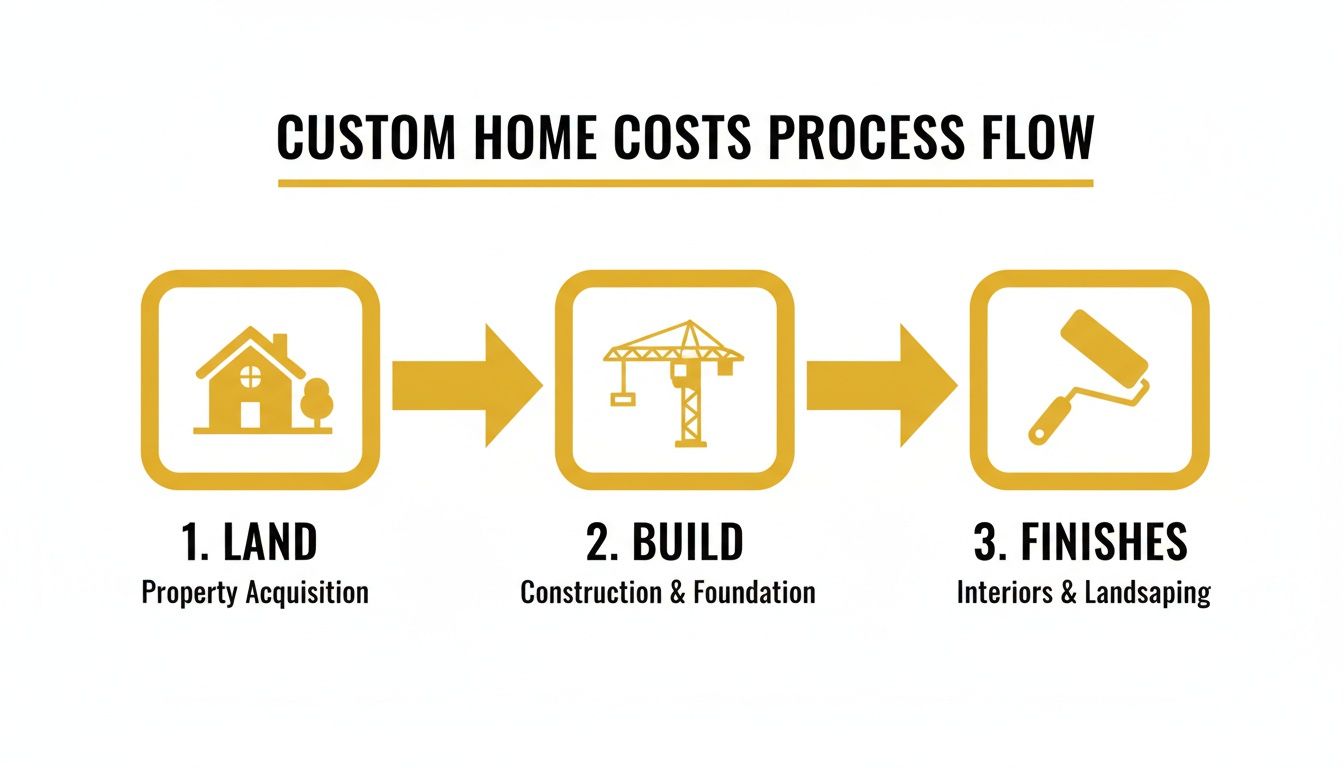
As you can see, the journey is a clear progression. The foundational costs lead into the major construction phase, which all culminates in the personalized details that define your home.
Here’s a quick look at the major stages you'll see unfold:
- Foundation: After the site is cleared and graded, footings are dug and the foundation is poured. This is the structural base of your entire home, and its integrity is everything.
- Framing: This is when your home suddenly looks like a house! The walls, floors, and roof structure go up, and you can walk through the rooms for the very first time. It's a huge moment.
- Rough-Ins (Mechanicals): Before any drywall goes up, plumbers, electricians, and HVAC technicians run all the pipes, wires, and ductwork through the walls. This is also a critical inspection point.
- Exterior Finishes: While the interior work is happening, the outside of your home comes to life with siding or brick, windows, doors, and roofing.
- Insulation and Drywall: This stage is transformative. Once insulation is in and the drywall is hung and finished, the open framework becomes defined rooms. Your house starts to feel like a home.
- Interior Finishes: Now the personality comes through. Flooring is installed, cabinets and countertops are set, walls get painted, and light fixtures and faucets are put in place.
- Final Walkthrough and Punch List: Before we hand over the keys, we’ll do a detailed walkthrough with you. We'll create a "punch list" of any final items that need adjustment, ensuring every single detail is perfect.
"Our process is designed to be a transparent journey. Clients have a clear view of the schedule and know exactly when their input is needed for selections. This collaboration is what turns a well-built house into their perfect custom home." - A Past ACET Custom Homes Client
An experienced team manages this entire workflow, skillfully scheduling trades and ordering materials to keep the project moving forward. Understanding this sequence helps you appreciate the complexity involved and see the tangible progress being made each week. For an even more detailed look, you can explore our complete guide to the custom home building process.
Building a Home That Can Handle Oklahoma Weather
Let's be honest: building a luxury home in Oklahoma means you're building a fortress. It has to be beautiful, of course, but it also needs to be high-performing, comfortable, and tough enough to handle everything our demanding climate throws at it. As an experienced Oklahoma custom home builder, we know that smart design is about far more than what you see on the surface. It’s about creating a home that’s durable, healthier for your family, and cheaper to run every single month.
This isn’t about chasing fleeting trends. It's about a practical, forward-thinking approach to home construction that pays you back in real dollars on your utility bills.
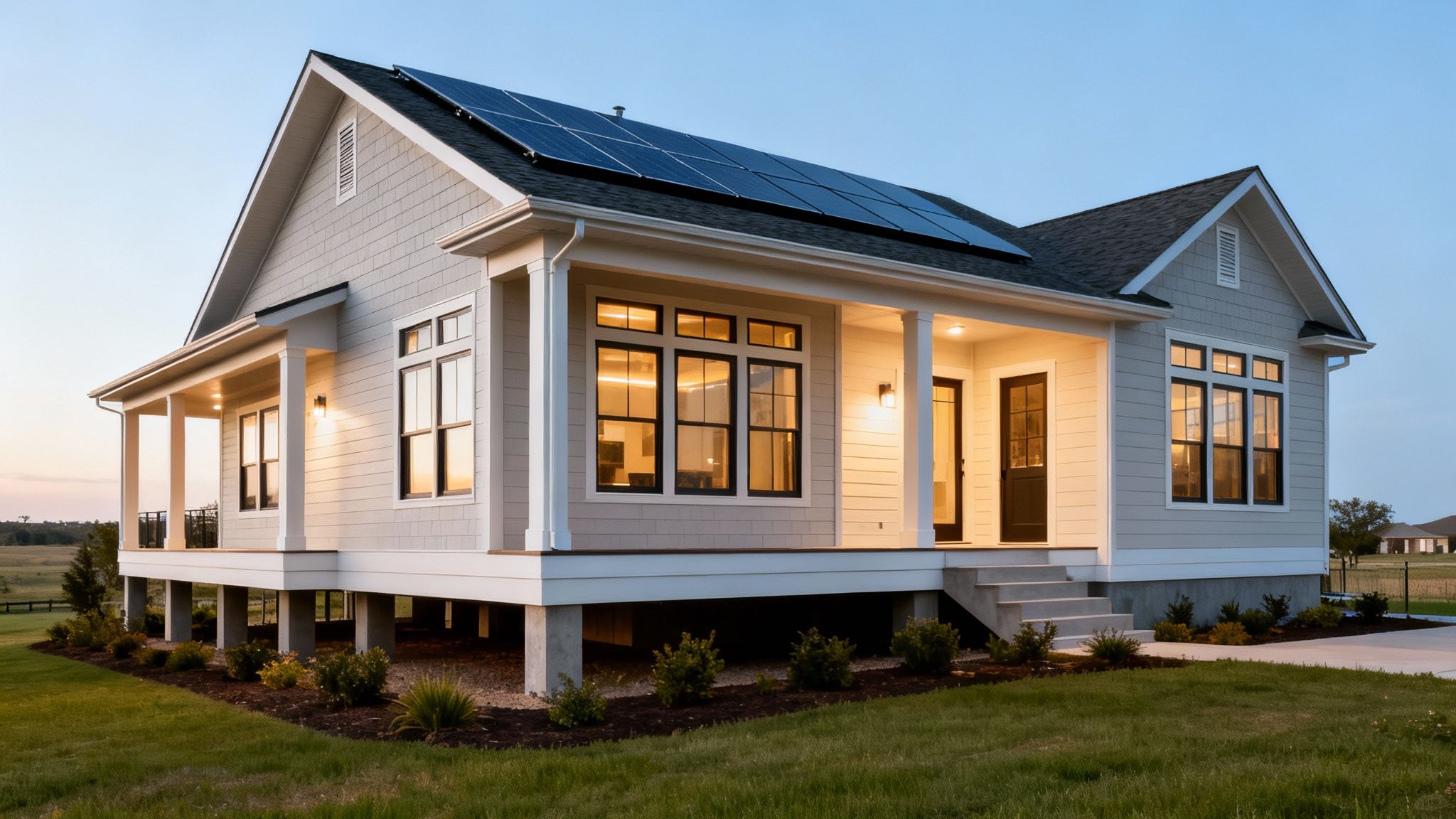
From the sweltering OKC summers to those bone-chilling winter winds that howl across Elmore City, your home's exterior shell—what we call the building envelope—is its most important line of defense. Get that right, and you've won half the battle for comfort and efficiency.
High-Impact Features for Oklahoma Homes
When you're looking at energy-efficient upgrades, some will give you a much bigger bang for your buck than others. With our 15+ years of building experience, we’ve learned to focus on the systems that truly make a difference in your daily comfort and long-term savings.
Here are the essentials we recommend for any custom build in Oklahoma:
- Advanced Insulation: We've moved way beyond the pink fiberglass batts of the past. Spray foam insulation is a complete game-changer. It creates an airtight seal that stops conditioned air from leaking out and prevents drafts, but it also adds structural rigidity and acts as a moisture barrier.
- High-Performance Windows: Your windows can be huge energy drains, letting heat pour in during the summer and escape in the winter. We insist on using Low-E (low-emissivity) coated, argon-gas-filled windows. These reflect infrared light, keeping your home cooler in July and warmer in January without you having to sacrifice all that beautiful natural light.
- Right-Sized HVAC Systems: When it comes to your HVAC, bigger is definitely not better. We run detailed calculations to install a system that’s perfectly matched to your home’s specific size, layout, and efficiency level. An oversized unit cycles on and off constantly, wasting a ton of energy and never properly dehumidifying the air.
"A well-insulated home with high-performance windows allows us to install a more efficient HVAC system. These components work together to create a home that maintains a consistent, comfortable temperature with less effort, which translates directly to lower energy bills for our clients." - Bono, Project Manager at ACET Custom Homes
Building for Durability and Resilience
Oklahoma weather isn't just about temperature swings. We have to prepare for high winds, hail, and the kind of thunderstorms that can rattle your nerves. This is where smart building practices become absolutely critical for creating a home that stands strong.
This is also where a builder's real-world experience comes into play. We think about everything, from the direction your home faces on your lot in Edmond to the specific materials we choose for the roof and siding.
Resilient Building Material Comparison
Making these choices is about building a home for the long haul. A house built with these considerations isn't just safer—it requires less maintenance over its lifetime, which preserves its value and gives you incredible peace of mind. In fact, the National Association of Home Builders estimates that investing in resilient construction can provide a return of $4 for every $1 spent by preventing future damages.
There’s no question: building it right the first time is always the most cost-effective strategy.
Frequently Asked Questions About Custom Builds
It's only natural to have a long list of questions when you're thinking about building a custom home. As a builder here in Oklahoma, we’ve heard just about all of them, and we believe in giving you clear, honest answers so you can feel confident taking the next step. Let's tackle some of the most common ones we get from our clients.
How Long Does It Take to Build a Custom Home in Oklahoma?
This is probably the number one question we hear. From our first design meeting to the day we hand you the keys, you can generally expect the process to take anywhere from 9 to 18 months.
So, what causes that big range? It really comes down to a few key things. A more complex architectural design will naturally take longer than a simpler one. The unique characteristics of your land—like a steep slope or heavy tree coverage—can also add time for site prep.
Then there's the permitting process, which can move at a different pace depending on whether you're building in a place like Edmond versus out in rural Logan County. And, of course, Oklahoma weather and the occasional supply chain hiccup for a specific material can always play a part. Choosing a unified design-build firm often helps keep things on track, since everyone is on the same team from day one.
What Is the Difference Between a Custom Builder and a Production Builder?
The difference is night and day, really. A production builder typically buys a large tract of land and builds a whole neighborhood using a small portfolio of pre-designed floor plans. You might get to choose your carpet color or cabinet style, but that’s usually where the personalization ends.
On the other hand, an Oklahoma custom home builder starts with a blank slate: your vision and your piece of land. We work with you to create a truly one-of-a-kind home from the ground up. Every detail—from the room layout and window placement to the specific stone for your fireplace—is chosen by you, for you. It’s all about creating a home that perfectly reflects your family’s lifestyle.
Can I Use My Own Architect with a Custom Builder?
Absolutely. Many clients come to us with plans they've already had drawn up, and most custom builders are happy to collaborate.
That said, there are some real advantages to working with a design-build firm that has architects and builders under one roof. When the design and construction teams work together from the very beginning, they can ensure the plans are not only beautiful but also practical and, crucially, within your budget. This integrated approach can save a lot of headaches and prevent the kind of expensive mid-project changes that sometimes happen when separate firms aren't perfectly in sync. The National Association of Home Builders (NAHB) has some great articles on this if you want to dig deeper.
What Kind of Warranty Should My New Custom Home Have?
Any builder worth their salt will stand behind their work with a solid warranty. It's a non-negotiable.
Here’s what you should look for as a standard:
- A one-year warranty covering workmanship and materials. This covers the "punch list" items—think paint, trim, fixtures, and making sure everything works as it should.
- A two-year warranty for your major mechanical systems. This includes your HVAC, electrical, and plumbing.
- A ten-year structural warranty. This is the big one, protecting the very foundation and frame of your home.
Always, always get the warranty details in writing. It's the ultimate protection for your investment and gives you genuine peace of mind for years to come.
Ready to design your custom home? Schedule a free consultation with ACET Custom Homes today.
Consultation Today!